Answers · Sabbatical
Can I afford a sabbatical?
Short answerAlmost always yes. If you cover the year off from cash reserves, a 12-month sabbatical usually delays your Optional Date by 7 to 15 months. The bill is the twelve months of contributions you skip and how long those had left to compound before you reached Optional.
A sabbatical feels irresponsible mostly because retirement calculators can't model one. This one can. Below: a live calculator, a worked example, and the formulas, so you can decide with the actual numbers in front of you.
Try it live
Model your own sabbatical
Type in your real numbers. Slide the length and the start date. The calculator shows the Optional Date without the sabbatical, the Optional Date with it, the delay, and what your portfolio does while you’re away.
12%
Funded today
Years to Optional
NOV 2046
vs baseline APR 2046
Delay: +7 months
Sabbatical length
Starts in
Portfolio at break start
$238K
Portfolio at break end
$253K
Missed contributions
-$22K
A modest delay, in the same neighborhood as the sabbatical itself.
Assumes you fund the year off from separate cash reserves, not by drawing down your invested portfolio — same model the Scenarios Lab uses.
Assumes a 7% average real return (after inflation) and a 4% withdrawal rate.
Plain-language
What the year off costs you
A sabbatical looks scary in a retirement calculator because a retirement calculator can’t model one. You enter a savings rate, a return, and an end date. There is no field for a year off.
If you fund the year from cash reserves you built for it, the invested portfolio isn’t touched. It keeps growing at market rates for those twelve months. What you lose is one year of contributions: the money you would have added and didn’t.
That’s a smaller cost than it feels like. Twelve months of $2,000 contributions is $24,000 today. In future value at Optional it’s more, because the money would have been compounding. Still a bounded, calculable number, and nothing like the “you’ll never retire” warning your parents will give you.
How much delay you get depends on how far you are from Optional when you take the break. Within a decade of Optional, a 12-month sabbatical usually delays it by 4 to 8 months. Two-plus decades out, 6 to 15 months. Slide the “starts in” chip on the calculator above to see the shift.
The one big assumption
The numbers above assume you cover the year from cash reserves you built before the break, not from your invested portfolio. If you sell investments to fund it, the delay grows sharply, often three to four times larger. The Scenarios Lab makes the same cash-funded assumption. If you’d be pulling from the portfolio, the better move is to build a cash bucket first and model that timeline instead.
Worked example
What a 12-month break actually costs
Case study — Maya, 36 — early career
Product designer in Seattle. $220,000 in her 401(k) and taxable brokerage. Saves $2,000/month across everything. Spends about $70,000 a year. She wants twelve months off in two years to travel and write. Everyone in her life is telling her she can't afford it.
Balance
$220,000
Monthly save
$2,000
Annual spend
$70,000
Sabbatical
12 months
Baseline Optional Date: December 2045, at age 56. About 19 years from now. She’s roughly 13% funded today: $220K against a $1.75M target.
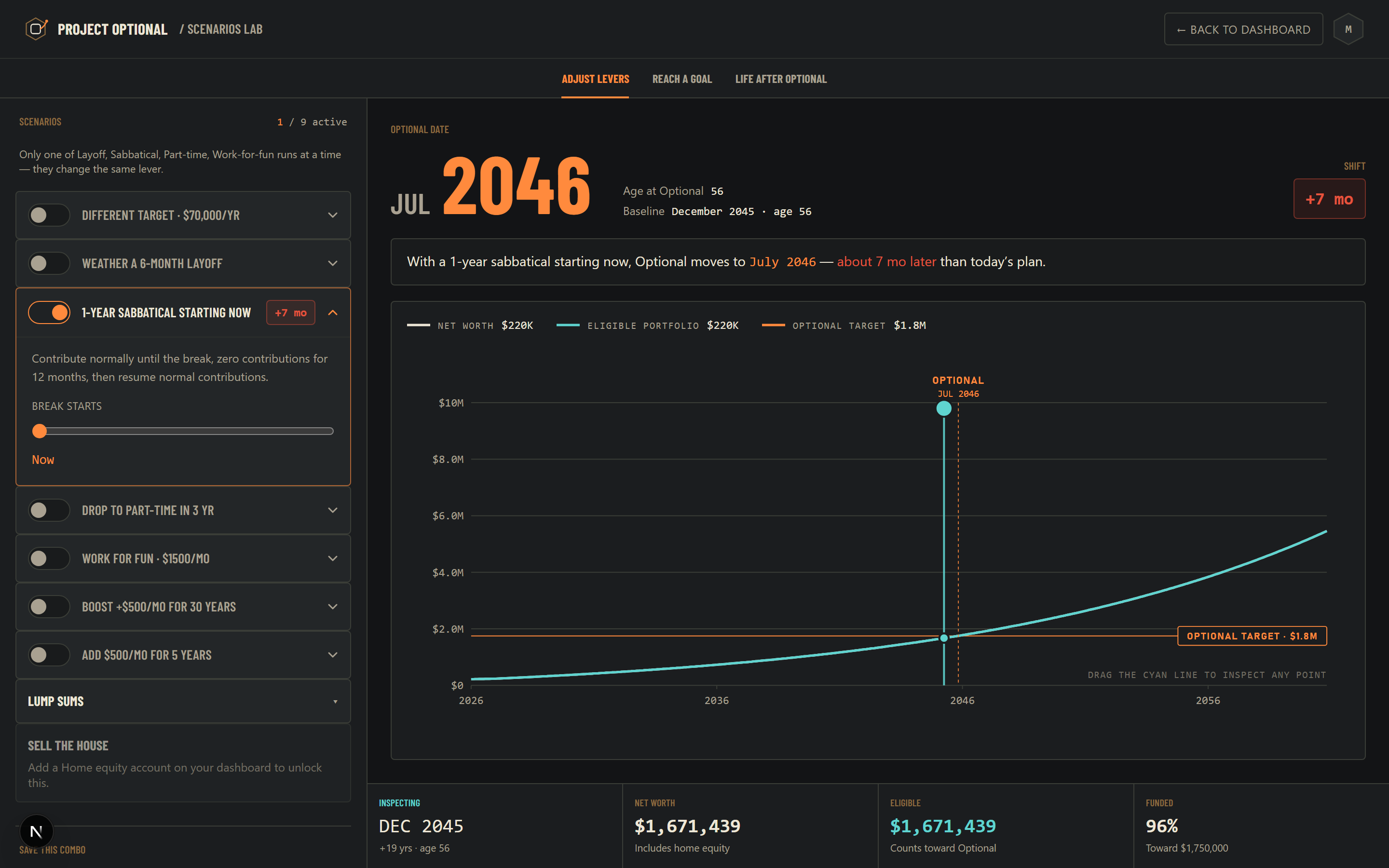
With the sabbatical, starting now: July 2046 in the Scenarios Lab. A 7-month delay. Her portfolio keeps growing during the year off, from $220K to about $235K, because compounding doesn’t stop when contributions do. The bill shows up entirely as the $24,000 of contributions she didn’t make.
Seven months, not seven years. For a year of doing something she’ll remember for the rest of her life, work becomes optional in July 2046 instead of December 2045.
The delay shrinks the longer she waits. Same sabbatical at 43 instead of 36: about 5 months. At 46: roughly 4 months. Closer to Optional means less time for the missed contributions to grow into a bigger gap. Slide the “starts in” chip on the calculator above from Now up to 10 years and watch it happen.
From the app
This decision, inside Project Optional
The same math runs live in the Scenarios Lab — alongside eight other scenarios you can layer on top (sell the house, drop to part-time, adjust returns, retire earlier). Once you’re signed in, you can save this as a named scenario and compare it side by side against your default plan.
Under the hood
Assumptions and formulas
Same engine as the rest of Project Optional. Nothing is hidden.
Optional Number = Annual Spending ÷ 4% = Annual Spending × 25
Each month steps forward. When you’re working, you contribute and the balance grows. During the sabbatical, contributions pause but the balance still grows at the market rate. Zero contributions in, no withdrawal out.
ending balance = starting balance × (1 + monthly return)
+ (working ? monthly contribution : 0)
monthly return = (1 + 7%)^(1÷12) − 1 ≈ 0.565%/month
- 7% average real return. Already inflation-adjusted, so your target stays flat in today's dollars. This matches Project Optional’s methodology page and doesn’t double-count inflation.
- 4% safe withdrawal rate, based on the Trinity Study. Adjustable inside the app; fixed at 4% on this page.
- You fund the sabbatical from cash reserves, not from your invested portfolio. The Scenarios Lab uses the same assumption.
- No income during the sabbatical. Freelance work, seasonal gigs, or any side income shortens the delay and isn’t modeled here (it is inside the app).
- No taxes on withdrawals. See the methodology page for why we leave taxes out of the projection itself. The Real-life limits section further down covers how taxes affect what you can actually spend.
- No Social Security. Every projection assumes zero government income once you stop working. In real life, factoring it in lowers the number you need.
Common questions
What people ask about this
Is it better to take a sabbatical earlier or later? Later is cheaper on the calculator: the missed contributions have less time to compound into a bigger gap. Later is often harder in real life. Kids, mortgages, and career gravity get heavier. The calculator shows the money side; you weigh the rest.
What if I work part-time during it? Then it’s not a sabbatical, it’s a part-time year, and the delay is much smaller.
Do I need a cash cushion on top of this? Yes. The calculator assumes you have one. In real numbers, you’d fund the sabbatical from a cash bucket built before the break and leave the invested portfolio alone. That’s why this reads as a 7-month delay and not a 20-month one.
Optional vs retirement
Work Optional isn’t the same as retirement.
Retirement says: work until you can afford to stop. Optional says: work until you can afford to choose. The math is the same: enough invested to fund your yearly spending indefinitely. The story around the number is completely different.
At Optional you have flexibility. Stay in the job you like. Drop to part-time. Move to a lower-paying role you’d enjoy more. Take a year off. Start something that pays nothing for its first three years. Or keep working the same job and never touch the money, because you’d rather have the option than the exit.
That’s what “Optional” means in Project Optional. Not a stop date. An unlock date: the day the money side of your life stops requiring the exact job you have now.
Real-life limits, what we don’t model yet
The projection shows growth. It doesn’t yet model the drawdown.
Project Optional projects your investments growing toward the number that funds your yearly spending. Pulling that money out is the last mile, and it has real-world limits worth naming:
- Taxes. Traditional 401(k) and IRA withdrawals are ordinary income (usually 10 to 24%). Taxable brokerage pays capital gains (0 to 15% for most). Roth withdrawals are tax-free once vested. Which account you pull from changes the take-home number, sometimes by a lot.
- Age limits. Traditional accounts carry a 10% penalty on withdrawals before 59½, with narrow exceptions like the Rule of 55 and SEPP. Roth contributions can come out anytime; earnings can’t until 59½ and a five-year hold. If your Optional Date lands before 60, sequencing matters.
- Fees. A 1% expense ratio subtracts a full 1% from your projected 7% real return, and it compounds. Over 30 years, that often eats 20 to 30% of the ending balance.
Tax-aware drawdown sequencing (the “which account do I pull from first” question, with age gates and RMDs baked in) is on the Project Optional roadmap. Today, Optional means enough invested to fund your yearly spending indefinitely. The withdrawal plan comes next.
Ready to run your own numbers?
Save this sabbatical and see it next to your real plan
Type your actual numbers into Project Optional, save this as a named scenario, and stack it against Part-Time, Sell-the-House, Lump-Sum, and six others. Every change updates every scenario, live.
Nothing here is advice.
Project Optional is a modeling tool, not a financial advisor. Real markets don’t grow at a smooth 7% every year. Real spending doesn’t stay flat. Real lives have surprises no calculator sees coming. Use what you see here to think through your options, not as a replacement for talking to someone qualified when you’re about to make a big decision.