Answers · Layoff
How damaging would a one-year layoff be?
Short answerLess than most people fear, if your cash cushion covers crisis-mode spending. On typical numbers, a 12-month layoff delays your Optional Date by 8 to 18 months when the cushion holds. When it runs out and you pull from investments, the delay grows to 24 to 36 months. Your cushion is the biggest lever.
A layoff isn’t a chosen sabbatical, so the math is different. Below: a live calculator, a case study, and the formulas that show how your cushion, your crisis spending, and the layoff length combine into the delay you’d actually see.
Try it live
Model your worst case
Type your real numbers. Set the layoff length, your crisis-mode annual spending, and how much cash cushion you have. The calculator shows the delay against your baseline Optional Date and how much of the shortfall your investments would have to cover.
19%
Funded today
Years to Optional (after layoff)
JAN 2044
vs no layoff DEC 2042
Delay: +13 months
Layoff length
Cushion runway
6 months
Portfolio draw needed
-$25K
Delay to Optional
+13 months
A cushion gap forces some portfolio drawdown, but the delay stays modest.
Assumes a 7% average real return (after inflation) and a 4% withdrawal rate.
Plain-language
Why your cushion decides the answer
A layoff hurts your Optional Date in two ways. First, contributions stop — the months you would have added to savings just don’t happen. Second, you still have to eat, and that money comes from somewhere.
If it comes from a cash cushion you built for exactly this purpose, the invested portfolio isn’t touched. It keeps compounding. The delay is roughly the missed contributions and nothing more — often less than a year for a year off.
If the cushion runs out and you have to sell investments to cover living costs, two things go wrong at once: the balance drops, and the compounding on that missing money continues to work against you for years. The delay grows sharply. This is the case your parents are warning you about; the fix is having the cushion, not avoiding the risk of layoff.
Cutting spending during the layoff shrinks both effects. Most people who’ve been through it will tell you they cut hard, fast — unemployment forces triage that you’d never do voluntarily. That’s why a real layoff usually delays Optional less than a chosen sabbatical at the same length would.
Worked example
What a real layoff costs
Case study — Sam, 42 — senior engineer, laid off
Sam has $340,000 in her 401(k) and brokerage. She was saving $2,200 a month and spending about $72,000 a year. She gets laid off, cuts spending to $50,000 a year in crisis mode (drops travel, delays big purchases, switches to a cheaper phone plan), and has a $25,000 cash cushion. She doesn't find a new job for 12 months.
Balance
$340,000
Save (normal)
$2,200/mo
Cushion
$25,000
Crisis spend
$50,000/yr
Baseline Optional Date (no layoff): about 17 years from now, at age 59.
Cushion runway: $25,000 / ($50,000/yr) = 6 months. Sam’s cushion covers the first half of the layoff. The second half is $25,000 of shortfall that has to come from investments.
Optional Date with the layoff: about 19 years from now — a 24-month delay. Twelve months of missed contributions plus $25,000 of forced investment sales.
If Sam had a $50,000 cushion instead: the cushion covers the whole layoff, no forced sales. The delay collapses to about 12 months — roughly the sabbatical answer. Same layoff, same crisis spending, but the cushion size cuts the delay in half.
From the app
This decision, inside Project Optional
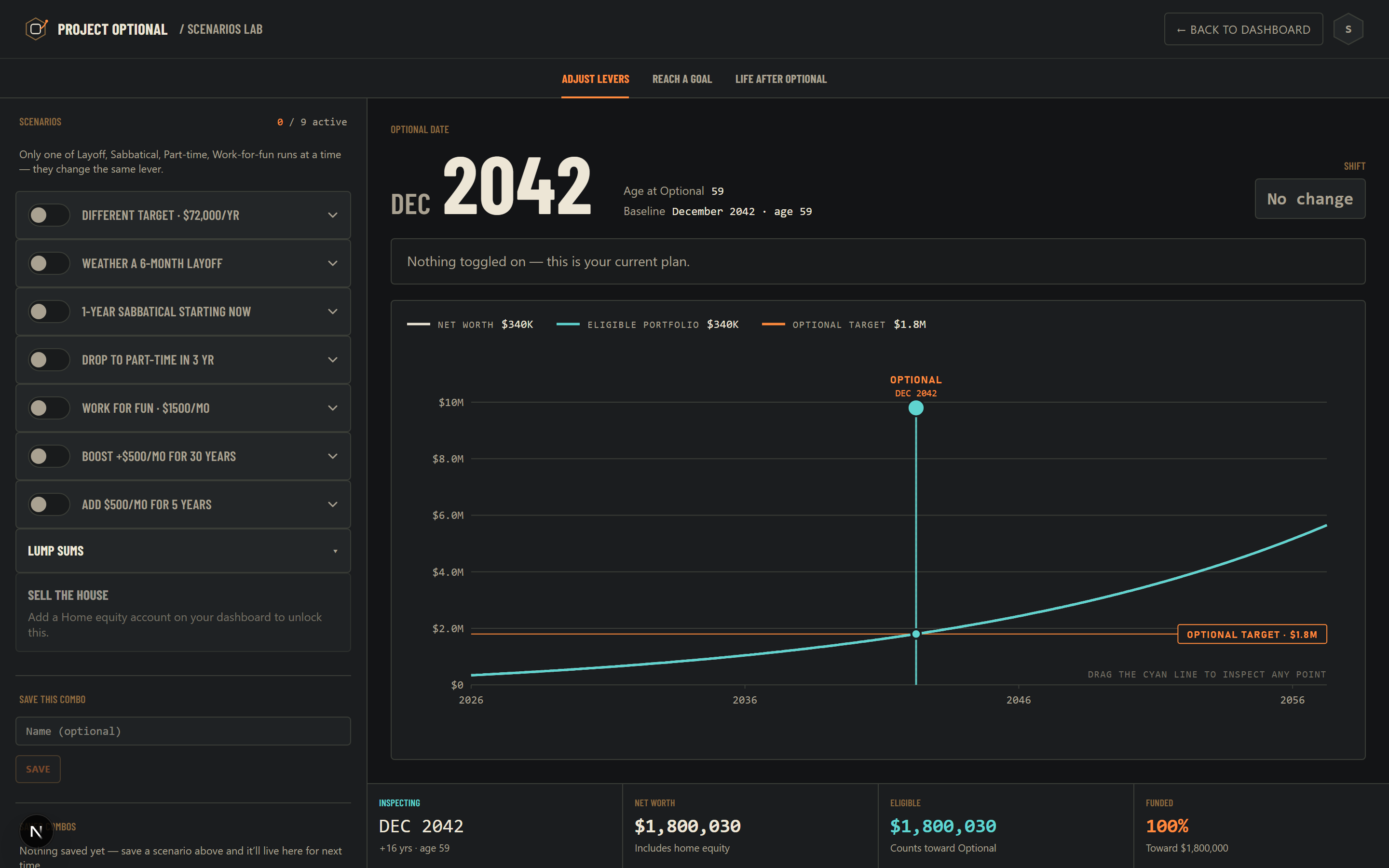
The same math runs live in the Scenarios Lab through the Layoff scenario. You can layer it against a Boost, a Different Target, and every other lever you’re considering, and see the combined delay in real time.
Under the hood
Assumptions and formulas
Same engine as the rest of Project Optional. Nothing is hidden.
Optional Number = Annual Spending ÷ 4%
During the layoff each month, spending is drawn from the cushion first. Any shortfall becomes a negative contribution — a portfolio drawdown:
during layoff:
draw = min(cushion left, monthly crisis spend)
cushion left −= draw
portfolio contribution = −(monthly crisis spend − draw)
after layoff:
portfolio contribution = normal monthly save
- 7% average real return. Already inflation-adjusted, so your target stays flat in today’s dollars.
- 4% safe withdrawal rate. Adjustable inside the app; fixed at 4% on this page.
- The cushion is spent first, in order. No cash held in reserve during a layoff.
- No unemployment benefits or severance modeled here. If you have those, subtract them from crisis spending directly.
- No side income during the layoff. Freelance or seasonal work shortens the delay materially — model that inside the app.
- No taxes on withdrawals. Portfolio drawdowns triggered by a layoff can carry meaningful tax effects; see the Real-life limits section below.
Common questions
What people ask about this
How much cash cushion do I actually need? Enough to cover crisis-mode spending for as long as the layoff plausibly runs. The classic three-to-six-months isn’t enough for a full year unemployed. Use the calculator to set the cushion equal to your crisis spending times your worst-case layoff length.
Should I save aggressively or hold more cash? Both, honestly. The right cushion is a fixed amount (measured in months of crisis spending), not a percentage of your portfolio. Once you’ve got it, keep saving normally.
What if I get severance? Effectively that’s a bigger cushion. Add it to the cushion input on the calculator and watch the delay shrink.
Optional vs retirement
Work Optional isn’t the same as retirement.
Retirement says: work until you can afford to stop. Optional says: work until you can afford to choose. The math is the same: enough invested to fund your yearly spending indefinitely. The story around the number is completely different.
At Optional you have flexibility. Stay in the job you like. Drop to part-time. Move to a lower-paying role you’d enjoy more. Take a year off. Start something that pays nothing for its first three years. Or keep working the same job and never touch the money, because you’d rather have the option than the exit.
That’s what “Optional” means in Project Optional. Not a stop date. An unlock date: the day the money side of your life stops requiring the exact job you have now.
Real-life limits, what we don’t model yet
The projection shows growth. It doesn’t yet model the drawdown.
Project Optional projects your investments growing toward the number that funds your yearly spending. Pulling that money out is the last mile, and it has real-world limits worth naming:
- Taxes. Traditional 401(k) and IRA withdrawals are ordinary income (usually 10 to 24%). Taxable brokerage pays capital gains (0 to 15% for most). Roth withdrawals are tax-free once vested. Which account you pull from changes the take-home number, sometimes by a lot.
- Age limits. Traditional accounts carry a 10% penalty on withdrawals before 59½, with narrow exceptions like the Rule of 55 and SEPP. Roth contributions can come out anytime; earnings can’t until 59½ and a five-year hold. If your Optional Date lands before 60, sequencing matters.
- Fees. A 1% expense ratio subtracts a full 1% from your projected 7% real return, and it compounds. Over 30 years, that often eats 20 to 30% of the ending balance.
Tax-aware drawdown sequencing (the “which account do I pull from first” question, with age gates and RMDs baked in) is on the Project Optional roadmap. Today, Optional means enough invested to fund your yearly spending indefinitely. The withdrawal plan comes next.
Ready to run your own numbers?
Model your worst case, and the plan that survives it
Type your actual numbers into Project Optional, turn on the Layoff scenario, and stack it against the boost, sabbatical, and part-time scenarios in the Lab.
Nothing here is advice.
Project Optional is a modeling tool, not a financial advisor. Real markets don’t grow at a smooth 7% every year. Real spending doesn’t stay flat. Real lives have surprises no calculator sees coming. Use what you see here to think through your options, not as a replacement for talking to someone qualified when you’re about to make a big decision.