Answers · Boost
If I save an extra $500 a month, when can I retire?
Short answerSooner, by real years. On typical numbers, an extra $500 a month pulls your Optional Date forward by 1 to 3 years. Earlier in your career, the pull is bigger because the extra money has decades to compound.
“Retire” is the phrase people search for. We answer it as Work Optional. Below: a live calculator, a case study, and the formulas that show how much the boost is worth against your own numbers.
Try it live
Try the boost against your numbers
Type in your real numbers. Slide the extra amount and how long you can keep it up. The calculator shows the baseline Optional Date, the boosted Optional Date, and the exact pull-forward.
12%
Funded today
Years to Optional (boosted)
FEB 2045
vs baseline FEB 2047
Pull-forward: 24 months sooner
Extra per month
Keep it up for
Total extra contributed
$180K
Pull-forward
24 months sooner
Optional Target
$1.50M
A meaningful pull-forward. Optional lands more than a year sooner.
Assumes a 7% average real return (after inflation) and a 4% withdrawal rate.
Plain-language
Why $500 a month is worth more than $500 a month
The value of a monthly boost isn’t the boost itself. It’s what that money compounds into by the time you reach Optional.
$500 a month over 30 years is $180,000 in nominal contributions. At a 7% real return, the same money compounds to roughly $610,000 in today’s dollars. That’s the reason a modest bump this year can pull your Optional Date forward by real years, not weeks.
The lever loses power the closer you are to Optional. Ten years out, a $500 monthly boost typically pulls the date forward by 12 to 18 months. Two years out, it’s often less than 4 months. There’s not enough runway left for the boost to compound into something game-changing.
Worked example
What a real boost does
Case study — Alex, 34 — software engineer
Alex has $180,000 across his 401(k) and taxable brokerage. He saves $1,500 a month and spends about $60,000 a year. His employer just gave him a raise and he's wondering whether the extra $500 a month is worth investing or spending. Everyone tells him the difference is small.
Balance
$180,000
Monthly save
$1,500
Annual spend
$60,000
Boost
+$500/mo
Baseline Optional Date: about 23 years from now, at age 57. He’s roughly 12% funded today ($180K against a $1.5M target).
Boosted to $2,000 a month for 30 years: about 20 years from now — roughly 3 years sooner. Total extra contributed: $180,000. Value of that money at Optional: much larger, because it compounded the whole way.
The rate at which the boost matters is the lesson worth carrying. If Alex only kept up the boost for 5 years and then stopped, the pull-forward shrinks to about 15 months. Consistency across decades is what bends the curve, not the size of any one raise.
From the app
This decision, inside Project Optional
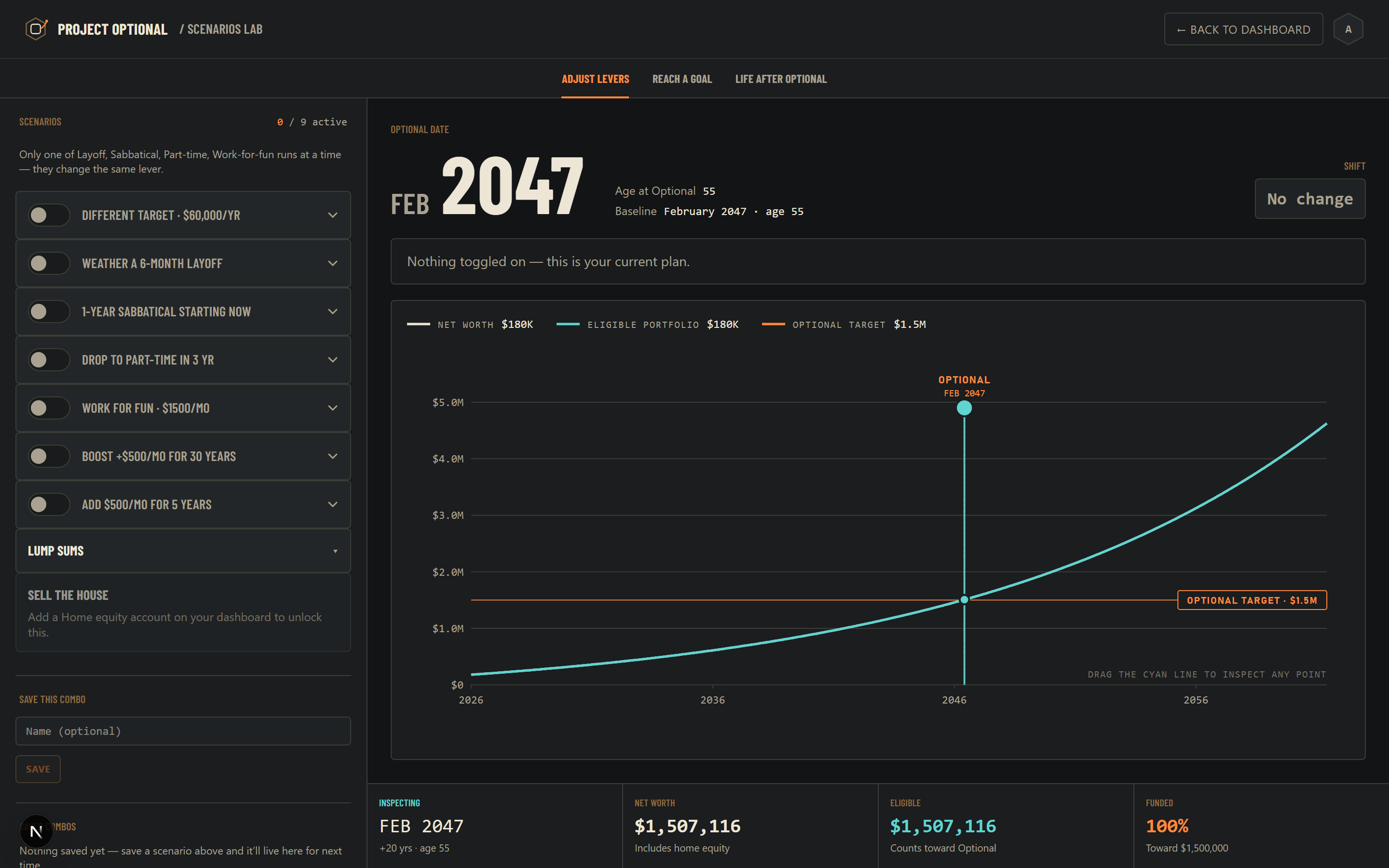
The same math runs live in the Scenarios Lab. Sign in, type your numbers once, turn on the Boost lever, and compare the boosted Optional Date against your default plan side-by-side.
Under the hood
Assumptions and formulas
Same engine as the rest of Project Optional. Nothing is hidden.
Optional Number = Annual Spending ÷ 4% = Annual Spending × 25
Each month steps forward. Your balance grows at the monthly return, then adds your normal contribution plus the boost:
ending balance = starting balance × (1 + monthly return)
+ monthly contribution + boost
monthly return = (1 + 7%)^(1÷12) − 1 ≈ 0.565%/month
- 7% average real return. Already inflation-adjusted, so your target stays flat in today’s dollars. This matches Project Optional’s methodology page and doesn’t double-count inflation.
- 4% safe withdrawal rate, based on the Trinity Study. Adjustable inside the app; fixed at 4% on this page.
- The boost is a real monthly addition, not a one-time bump. If the raise stops, the delay-reduction stops with it.
- No taxes on withdrawals. See the Real-life limits section below.
- No Social Security. Every projection assumes zero government income once you stop working.
Common questions
What people ask about this
Is $100 or $250 a month worth it? Yes. Any amount that keeps compounding for a couple of decades pulls the date forward. A $250 monthly boost held for 30 years typically brings Optional 12 to 20 months closer on standard numbers.
What if I have to stop the boost after a few years? Then the pull-forward is much smaller. A five-year boost is still worth doing, but the impact is measured in months rather than years. Slide the “keep it up for” chip on the calculator to see the difference.
Should I boost my 401(k) or my brokerage? On the math in the calculator, either. On the real math, the 401(k) is usually better because of the pre-tax deduction, but that difference isn’t modeled here. See the Real-life limits section below.
Optional vs retirement
Work Optional isn’t the same as retirement.
Retirement says: work until you can afford to stop. Optional says: work until you can afford to choose. The math is the same: enough invested to fund your yearly spending indefinitely. The story around the number is completely different.
At Optional you have flexibility. Stay in the job you like. Drop to part-time. Move to a lower-paying role you’d enjoy more. Take a year off. Start something that pays nothing for its first three years. Or keep working the same job and never touch the money, because you’d rather have the option than the exit.
That’s what “Optional” means in Project Optional. Not a stop date. An unlock date: the day the money side of your life stops requiring the exact job you have now.
Real-life limits, what we don’t model yet
The projection shows growth. It doesn’t yet model the drawdown.
Project Optional projects your investments growing toward the number that funds your yearly spending. Pulling that money out is the last mile, and it has real-world limits worth naming:
- Taxes. Traditional 401(k) and IRA withdrawals are ordinary income (usually 10 to 24%). Taxable brokerage pays capital gains (0 to 15% for most). Roth withdrawals are tax-free once vested. Which account you pull from changes the take-home number, sometimes by a lot.
- Age limits. Traditional accounts carry a 10% penalty on withdrawals before 59½, with narrow exceptions like the Rule of 55 and SEPP. Roth contributions can come out anytime; earnings can’t until 59½ and a five-year hold. If your Optional Date lands before 60, sequencing matters.
- Fees. A 1% expense ratio subtracts a full 1% from your projected 7% real return, and it compounds. Over 30 years, that often eats 20 to 30% of the ending balance.
Tax-aware drawdown sequencing (the “which account do I pull from first” question, with age gates and RMDs baked in) is on the Project Optional roadmap. Today, Optional means enough invested to fund your yearly spending indefinitely. The withdrawal plan comes next.
Ready to run your own numbers?
Save this boost and see it next to your real plan
Type your actual numbers into Project Optional, turn on the Boost lever, and stack it against sabbaticals, layoffs, and every other scenario in the Lab.
Nothing here is advice.
Project Optional is a modeling tool, not a financial advisor. Real markets don’t grow at a smooth 7% every year. Real spending doesn’t stay flat. Real lives have surprises no calculator sees coming. Use what you see here to think through your options, not as a replacement for talking to someone qualified when you’re about to make a big decision.